



Japanese Book Translations
The publishing division of this website, neOnbubble Press, has had a long and varied history but one of its key positions has always been providing translation services of foreign publications to English speakers. For this post I thought I’d share just a handful of some of the quality book translations into English that neOnbubble Press has provided to the Japanese book and magazine markets since 1962. Winning Business Meetings The Sharon Stone/Basic Instinct Way Taking inspiration from films to run businesses has always been the Japanese way and books promoting that ethos have always been popular. The march towards miniaturisation of almost everything, for instance, can be traced back to the 1966 movie Fantastic Voyage. In 1993 neOnbubble Press translated Winning Business Meetings The Sharon Stone/Basic Instinct Way, a book suggesting a lack of underwear and crotchless suits could accelerate any Tokyo businessman right to the very top. Sales were poor. The Big Book Of Buttocks Art In the 1970s three schools of Japanese erotic arts competed with one another in the publishing marketplace: schoolgirl fetishism, tentacle rape, and drawings on buttocks. A quick search on the internet for those search terms will tell you all you need to know about whether the market could support all three types of art (spoiler: it couldn’t) and why subsequent sales of The Big Book Of Buttocks Art as translated and printed by neOnbubble Press were so poor. Why Can’t Women Understand The Rules Of Golf? Misogyny is prevalent in Japanese culture and that’s despite such groundbreaking books as Why Can’t Women Understand The Rules Of Golf?, published by neOnbubble Press in 1985, which sought to provide questions and answers to how women differed from men in stereotypically manly activities such as golf, karaoke, jerking off to schoolgirl fetishism and tentacle rape comic books, and alcoholism in a bid to promote discussions of equality. Sales were poor. Techniques Of Hat Wearing – Fifth Edition Throughout much of the eighties hat wearing enjoyed great popularity in Japan, and especially in Tokyo where there was a genuine (though unfounded) concern that neon leakage from signs could lead to hair loss. Many books on the subject had been printed and one of the most successful was Techniques Of Hat Wearing which had enjoyed three reprints with additions before neOnbubble Press was invited to translate and print a new one especially targeted at the emerging English-speaking market in the capital. Three weeks before the book hit the shops a scientific report allayed the public’s fears regarding neon leaks and the fad of hat wearing came to an abrupt end. Sales of the publication were poor. After...
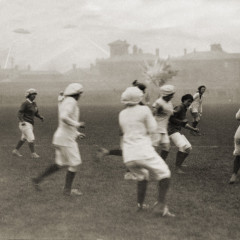
Portsmouth, Alien Invasion 1915 – 1923
Even as World War One (or as it was known at the time: Euroskirmish: The Bombening) took place, distracting much of Europe and – eventually – America too the Earth was beset by yet more warfare threatening to engulf humanity. This time it wasn’t the dastardly Kaiser responsible but an alien species whose origin and name were never determined for certain but who became known to the history books as The Squirmy Munge. The Squirmy Munge picked the prize naval port city of Portsmouth, England as their beachhead target for many obvious reasons, not least of which was the recent accolade of “Really Quite Charming City” in International City Revue, December 1914 edition. Unfortunately for The Squirmy Munge they hadn’t counted on the indomitable fighting spirit of the inhabitants of Portsmouth. And so it was that for eight years a series of invasions, stunning defensive actions, and retaliations became normal behaviour for the south coast of Britain quite separate from what was occurring in the fields of France and Belgium. The people of Earth owe a great deal to Portsmouth for eventually teaching The Squirmy Munge that the cost of war on the planet was too high even for spacefaring species with advanced weaponry. Above: a women’s football match takes place in Portsmouth while The Squirmy Munge undertake a daylight raid on the city in the...

History: America’s Dust Bowl
Reproduced with permission from the neOnbubble Learn You Some History series of student learning guides. This is a concise guide to the 1930s’ Dust Bowl that occurred on the prairies of America using photographs from the Library of Congress. America faced a problem in the 1930s. The Great Depression meant that average people couldn’t afford to buy foodstuffs that were grown by farmers throughout the states of Oklahoma, Texas, New Mexico, Kansas, and Colorado. This in turn left the farmers with a surplus of crops but no means of selling enough to pay for the luxuries to which they’d become accustomed: champagne, personal dirigibles, butlers, etc. Insanity threatened the farmers’ existence and some took to synchronised vegetable-picking much to the embarrassment of the wider American public. An ingenious plan was enacted by Secretary of Agriculture Henry Wallace to encourage farmers to grow a different sort of crop, one that would be free to the people of America and would give the unemployed something to do. That crop was dust. The idea was that by distributing dust freely people would be obliged to clean up a bit more giving them essential training for farmers’ butler and maid roles when the economy picked up. The farmers would be compensated for the new crop from federal coffers. Roy Kimmel of Texas coordinated the efforts. Prairie farmers quickly adapted their land to grow the new dust, often producing far more than they could reasonably store in sheds. New farming techniques needed to be learnt too. Tractors and dirigible-drawn ploughs were of no use in dust farming, the work requiring more manual labour. Farmers needed to wait for the right height of dust build-up before harvesting which led to booming business for the Oklahoma Measuring Stick Company, one of the few success stories of that period in America’s history. Dust distribution was highly successful, managing to blot out the sun when released in storms and culminating in huge amounts of cleaning throughout much of the midwest of America. The area soon became known as the Dust Bowl. Despite the apparent successes, however, it emerged in 1935 that there was a serious side effect to the dust crop. Physical disabilities of the young started to increase within the affected regions. In particular, Cranium Gigantism emerged mostly in boys leading to the adoption of oversized headwear. Dust Bowl farmers were reluctant to alter their farming techniques again even with the removal of the subsidy. The American government was forced to intervene in late 1937 and used its weather machine located in St Louis to drench the area and destroy the remaining crops. The production of so...

A Visit To Old Angelfire
In the olden days when the internet was young there rose from its vast sea glittering towers, home to people from far and wide, places where strangers could form communities and friendships. These towers had strange, exotic names like Tripod or Geocities or Angelfire. Tiled backgrounds and animated graphics were almost mandatory. Marquee text was currency. Lime green Times New Roman text was the status symbol of choice. Mostly. They weren’t pretty to look at is what I’m saying. The internet grew up and the towers shut their doors as the people built their own homes elsewhere. Some of them relocated. But some of the old towers remained. They were boarded up, uncared for, covered in graffiti, and smelled of wee, but they stayed standing, entombing memories of their past within. And it’s still possible to take a look around if you know how. I know how and I’ve just had a wander around old Angelfire for old times’ sake. It’s an old man with his cock in his hand (snigger). It’s actually from this page on Argentinian combat chickens. And I can finally remove “Argentinian combat chickens” from my list of phrases to publish on the web. What you’re looking at above – via this page (tiled background ahoy!) – is a screenshot of the VPlaces software running on Excite Talk, the virtual chatroom that I spent an awful lot of time on in the late 1990s. I loved that software. I loved the modified DLLs that you could download that made your avatar twice the size or gave you the ability to empty rooms or enter them even if they were full. I loved that it used the Visual Basic 4 runtime. Ah, memories. Okay, now this was a surprise because it’s, well, it’s quite good. I know. By Neena Bickram in 1998 this comes from a page titled The Tale of the Parking Meter God. It’s a photo story, it’s not a long read, but it’s well done. Go and read it. And when you’ve done that check out Neena’s Angelfire site more fully. Expect ponies. Expect fantasy. A fan-made desktop wallpaper of Keira Knightley and there are plenty more if your eyes can stand it on this page. The original image was 800 by 600 pixels in size. Can you imagine a desktop with that resolution now? It’s terrifying isn’t it. Parties were better in the days of Angelfire as this picture demonstrates. More party pictures from Paul “Gumby” Trusten are here in case you want to live the hedonism of alcohol and vest-wearing vicariously through them. A superheroine in bondage? Oh my! Yes, it’s...

Star Trek Endings
Today I watched the final ever episodes of Star Trek: Deep Space Nine, a mere fifteen years after it aired. The reason for the slight delay is one of bad luck and odd repeat-showing practices by the people in charge of such things. I never saw the final series of DS9 when it was first shown and every time I’ve seen the series being repeated, for some reason, the last season was never part of the cycle. Sure, I could have bought the last season on DVD but then I would have had to buy all of them because anybody who just purchases the final season of a television show gets put on a list of suspected psychopaths. That’s a fact. But anyway, SyFy finally came through and delivered season seven of Deep Space Nine and that meant that over the last few weeks I have finally, finally watched every single episode of every single Star Trek franchise. And… relax. And that means I can now give my thoughts about Deep Space Nine’s last season as well as a comparison of the endings of each of the series. Overall, I liked Deep Space Nine. The setting and general story arc worked well and if I were to rate the four non-TOS series (I’m not counting the original series because, well, I’m not and you can’t make me) in order of how much I liked them then – and this probably runs counter to a lot of people but that’s what makes the world a special place – for me it would be Enterprise, then Deep Space Nine, Voyager, and finally The Next Generation. Controversial, eh? As for the final season of Deep Space Nine itself there was one thing I didn’t like at all: Ezri Dax. Ezri Dax and all things Ezri Dax-related. The Worf/Jadzia/Ezri problem. The Ezri/Bashir love explosion. The counsellor on a warship bridge problem. The space sickness crap. The fact she looks younger than Nog. The acting using facial expressions (this is my confused face… and this is my worried face… and this is my worried and confused face). I didn’t buy into her at all. She was a decidedly weak link. I did like Vic Fontaine, though, but that may harbour back to my love of all things retro. And who doesn’t like a crooner? Nobody, that’s who. The one thing that really struck me about Vic, however, was how familiar he looked. At first I assumed he was a real singer but it took me a while to look him up (on those internets no less!) and that’s when I realised where I knew...
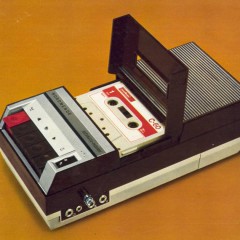
Vintage Technology
A small selection of vintage pieces of technology, some of which were precursors to more modern technological marvels and others of which were unique in the history of invention. Nordmende NASEX-1 Manufactured in Germany in 1970, the NASEX-1 was the only attempt by Nordmende to enter what many European companies were hoping would be dubbed “The Smelly Seventies” (although, thanks to their various native languages this term only worked alliteratively in the United Kingdom and no companies there wanted to take part); technology that excited the nasal senses was anticipated to be the next big thing. The NASEX-1 worked with special cassette cartridges to produce pleasing smells in a manner “composed” by scent artists. Unlike modern plug-ins that simply use perfumes, the cassettes for the Nordmende device contained electronic instructions for the machine so that it could manufacture the chemical smells internally. A combination of requiring eight 1.5V batteries, five key chemical capsules in the device, and cassettes to generate the odours made the NASEX-1 very expensive and it never achieved enough sales to warrant its continued manufacture past 1971. The best-selling cassette for the Nordmende NASEX-1 was Mein Haus by Karlheinz Stockhausen, described as “a nasal exploration of my home in Kürten”. In it Karlheinz took the smeller through his garden, his kitchen, his library, and his sex dungeon in a series of distinct pieces. Toshari M3/A “Tricorder” It’s quite likely that you won’t have heard of the Tokyo-based Toshari company or its flagship 1981 invention, the M3/A, dubbed the “Tricorder” by those few people who used it, were Star Trek fans, and lived to tell the tale. The M3/A was a handheld device designed to be used by medical professionals in quickly diagnosing a wide range of illnesses and diseases. The device had a clamshell form factor with a lower section containing scanning parameter selection through a cursor input system and an upper section containing a monochrome display and the scanning equipment itself. Although the M3/A was only initially configured to identify two dozen common illnesses Toshari had designed the system to be upgradeable with swappable ROM chips in its base. That, however, was not the root cause of its swift demise in the marketplace. Because of a government-driven desire for technology of this type the normal testing processes were shortened somewhat, sadly with lethal consequences. The Toshari M3/A’s scanner used unshielded gamma rays to perform its numerous analyses and both users and patients alike soon succumbed to a number of side effects including, unfortunately, fatal Godzillaitis. It was only the M3/A’s superior abilities to detect that very same common Japanese illness that enabled the device to...
Recent From Retro
-
 The Women Of Kilobaud Computing Sep 26, 2016
 -

-

-

-

-

Recent From Entertainment
-
 Dance Music Triple Nov 19, 2016
 -

-

-

-
-

Recent Comments